I believe our yoga practice should help bring our bodies into balance. Yoga poses and movements can serve as a therapeutic method of undoing the postural habits we build up through our daily activities, such as driving, chopping vegetables, sitting at a desk or carrying a child. A backbend, for most of us, is probably as far from our habitual postures as we can get (unless you are employed in a circus), and thus, is the perfect counterpose to daily life.
In terms of sensation and self-expression, backbends are liberating and energising. Indeed, some of my yoga students who are prone to insomnia, need to go easy on these stimulating poses at an evening class to avoid having a sleepless night.
Unlike forward bends, which soothe the nervous system, guiding our awareness inward and encouraging the front of the body to soften, backbending involves exposing our vulnerable underbellies to the world. We are required to free up our thoracic spines, open our hearts and release our emotions – its powerful stuff! This counter-instinctive action is something we can only do with ease when we feel completely safe. So, why would we just launch into backbends without preparation? Without gently mobilising the spine and preparing the ground safely, our task will be challenging. A tree cannot grow up to the sky without the anchoring power of its roots.
Each one of us, from the stiffest newbie to the super-flexible yogini, needs to practice backbends with acute awareness. All poses should be practised so, but because of the relative unfamiliarity of this movement for the body and the tendency to overbend the more mobile areas of the lumbar spine and neck, we need to have crystal clear minds and wide-awake senses.
Anatomically, there is a lot going on when we extend our spines into these beautiful arcs. Moving slowly into a backbend and gradually increasing its depth and intensity is essential. This allows the anterior longitudinal ligament at the front of the spine (which is less elastic than those ligaments at the back, and slower to respond) time to stretch. Bodyworker Tom Myers calls this ligament ‘the most important soft tissue in the body’ because the heart and abdominal organs literally hang off it. The visceral quality of some backbends like wheel (chakrasana) can be explained by the stretching of this ligament and the entire deep front line, which also incorporates the iliopsoas muscle and the diaphragm. It’s clear that flexibility of the front of the body and responsiveness of its fascia is requiredto allow us to bend backwards with freedom.
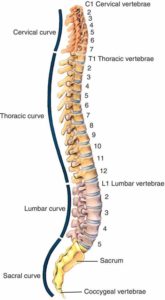
The shape of the spine must also be considered. When we look at the spinous processes (the parts of the vertebra that jut out towards the back, which we can feel when we touch our rounded spines with our fingers), we notice that their lengths and orientations change from the neck down towards the sacrum. The short, squat spinous processes in the lumbar spine make it easy for this area to backbend. However, the long spinous processes in the neck and thoracic spine will easily grind against each other if we backbend too far. Their length varies slightly between individuals, which explains why some people have more supple upper backs than others. Another structural detail that determines how deeply each of us can backbend safely is the thickness of the intervertebral discs. According to osteopath and yoga teacher Peter Blackaby, ‘acrobats and contortionists have very thick discs, which allow a great deal of movement, particularly in the lumbar spine’. This means that no amount of practice will allow ordinary humans to backbend in this extreme way – it’s simply a matter of genetics.
These are some of the anatomical reasons that backbends should not be rushed. If our movements are mindless and automatic, we are almost certain to bring our bad habits to the fore and become driven by them. Instead, when we coax our spines into extension, for example, by easing slowly and mindfully into cobra pose (bhujangasana), we can improve our awareness of spinal articulation by sensing each vertebra moving individually, yet as part of the whole.
We cannot follow a step-by-step manual with the final product being a backbend. It just doesn’t work. Backbending might not happen in response to a teacher’s instruction. Especially if the teacher is attempting to push students to go further or to achieve results. This is potentially dangerous, and can result in pain or even injury if the student attempts to take their body where it is not willing or physically able to go.
In contrast, a teacher who has a deep understanding of the body will often recognise the need to hold students back, preventing them going too far too fast. If someone has had a rigorous training like gymnastics, those methods will need to be unlearned, which takes time. I remember John Stirk’s classes in Notting Hill Gate, where we spent ninety minutes on the floor moving very slowly in a trance-like state of calm and were then led to optionally unfold into backbends that felt almost effortless.
I had a love-hate relationship with backbends during my early yoga days. It took a few years to convince my lower back that it didn’t have to be the star of the show. For a long time I practised and taught very minimalistic backbends, searching for a gentle, evenly-spread movement in my spine. I was led by my senses – when it felt good, I knew I was on the right track.
I don’t believe it is the yoga teacher’s role to instruct, but instead to prepare, guide and assist students to recognise their boundaries, unravel their fears and inhibitions, then finally expose their hearts (when they are ready). An emotional release may accompany this! For this reason, a safe space is essential. Trusting that the teacher has safety as a guiding principle, as well as feeling held by a group of fellow students, allows us to surrender to the tremendous power of these cathartic and transformative yoga poses.
Backbends are magical and elusive. It is an intangible power that animates our spines spontaneously into such unfurling expression. We can build up the dry kindling and invite a fire to spark. We prepare, prepare more… breathe… invite… listen… wait… Sometimes the body responds. Sometimes it doesn’t. We might just ignite a flicker of inspiration, and then this mysterious electrical aliveness that courses through the spine and all the chakras….but we cannot do it. Refined attention provides a safe foundation, but the rest is pure creativity.