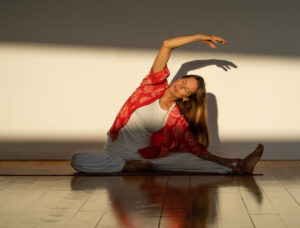
My body is naturally flexible. I discovered this as a child when I could entertain my mother and her friends by performing the poses in their yoga books with an ease that seemed to amaze them. Using the terminology of bodyworker and fascial expert, Tom Myers, I am a temple dancer rather than a Viking. Someone who has a temple dancer body type has a looser fascial net that is less capable of keeping the joints stable but allows flexibility. A person with a Viking body type has denser, stiffer connective tissue and more stability in their joints. Many athletes are built this way and seem to have natural strength but less flexibility. They are usually the people who can easily run a few kilometres but don’t enjoy stretching, although they would really benefit from it. As these fascial differences are determined by our genes, we can’t change our body types, but can work towards finding more balance by focusing on those activities that don’t usually come naturally to us.
In my case, and that of most temple dancers, our bodies benefit from building strength to boost the stability of our joints. When muscles become stronger, they can take on the role of supporting the joints in a way that our ligaments cannot do because they are too loose.
I won’t say I have a natural urge to power through endless planks and sit-ups —I would prefer to lounge around in deep, juicy stretches—but over the last seven years or so, I have come to realise the importance of developing my body’s strength. I would also add that for anybody over 40, strength work becomes a more important feature in our yoga practice in order to cope with sarcopenia, the natural loss of muscle mass as we age.
There is a down-side to being flexible, particularly in the case of joint hypermobility. People with this condition tend to flop into poses, hang off their joints and quite often end up injuring themselves by over-stretching during yoga.
Libby Hinsley sums up the challenges posed by hypermobility in her brilliant recent book, Yoga for Bendy People, in which she defines hypermobility as the ability of a joint to move beyond its normal range of motion. She highlights the difference between flexibility, which relates to muscles and mobility, which relates to joints and is determined by looseness in ligaments and tendons. Hypermobile connective tissue is loose or weak because of genetic differences in its collagen. This is why, unexpectedly, although hypermobile people have plenty of movement in their joints, they often experience muscle tension, as their muscles attempt to create stability.
In her fascinating book, Libby elaborates on various genetically-caused hypermobility syndromes, the most common being Ehlers-Danlos Syndrome (EDS) and Hypermobility Spectrum Disorder (HSD). People with these conditions tend to have hypermobile joints, very stretchy skin, scar easily and heal slowly. They are prone to other issues, like the tendency to dislocate joints and to suffer from sprains and strains. Their proprioception — the ability to sense the position of the joints in space— is often decreased, resulting in feeling clumsy or uncoordinated. The list of complaints that studies have shown to commonly affect hypermobile people is too vast to detail here. It includes headaches, auto-immune conditions, digestive disorders like IBS, eating disorders, problems with the vascular system and heart as well as mental health issues. The underlying cause of these problems is connective tissue laxity (floppiness) as a result of collagen fibres that are not as strong as they should be. As blood vessels and the other tubular structures in the body, like our intestines, are all essentially connective tissue, they are also affected.
Bendy people are attracted to yoga as it helps soothe and release the chronic muscle tension we often experience and, if practised with an emphasis on alignment and strength, it can build stronger muscles and more stable joints. However, with limited proprioception, it is more difficult for very mobile people to control their movements, especially when reaching a muscle’s end range—the furthest it can stretch—compromising the stability of the joint. For this reason it is recommended that bendy people stay in the safe zone: the mid-range where their joints are likely to be more stable and to avoid stretching to their limits.
Libby warns that: ‘extreme yoga poses may be fun from an acrobatic point of view, but…unless you are a circus performer, it’s not that useful. Life mostly happens in midranges, not at end ranges. Most of us aren’t training for the circus, we’re training for life.’
As health and movement professionals become more aware of these things, the information should filter through into the yoga world. So I find it surprising that social media is still adorned with images of yogis contorting their bodies beyond human recognition or sinking into extreme passive stretches. I occasionally see it in visiting students in my yoga class, who seem surprised when I guide their bodies out of a stretch instead of pushing them deeper into it.
Do the contortionist yogis out there know that this is unhealthy for their bodies? Do they feel pain the day after practising extreme poses? Or is the reward of attention and recognition addictive enough to ignore the consequences?
I remember when I started teaching yoga in England, I had a student in my class who was ridiculously flexible and possibly hypermobile. She would take her body to crazy extremes because if she didn’t, she said she couldn’t ‘feel the stretch’. I have continued to notice over the years that my more mobile students actually need to be held back from overdoing it and returned to their mid- ranges. At first they find it boring when their hunger for huge stretches is not being satisfied; however, with time I have noticed those students develop a natural sense of healthy alignment.
‘Yoga has nothing to do with acrobatics or spectacular exhibitionism, even though some poses rather look like it. Students are sometimes inclined to force the flexibility of their bodies to the maximum, but this leads nowhere.’ Vanda Scaravelli.
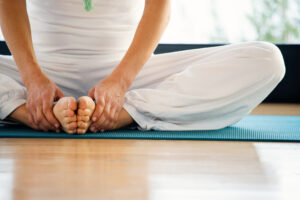
With a mixture of luck and choice, I have been fortunate to have had teachers who guided me to practice safely and with deep respect for my body. For many years I went to hatha yoga classes, mostly with teachers inspired by Vanda Scaravelli. Some of these teachers were trained osteopaths and fully aware of the importance of maintaining healthy joints. There was no sinking and flopping; we were taught to be alive and active, particularly through our hands and feet, but also throughout our bodies. With the awareness of a strong connection to the earth, working with ground reaction force (our response to gravity) there was a sense of the body being wide awake, making collapse quite difficult. This was not rigidity, but instead a feeling of responsiveness and freedom. These teachers seemed to be guided by Vanda Scaravelli’s wise words: ‘do not kill the instinct of the body for the glory of the pose. To be sensitive is to be alive.’
Newbie yoga students are often obsessed with becoming more flexible. When I started practising yoga at home regularly and began dreaming of teaching, I became preoccupied with stretching my hamstrings, especially those on the left, which were tighter than the right. Constant stretching seemed to have the opposite effect and I felt niggling aches at the back of my knees, where the hamstrings insert. When I went the opposite way and began to bend my knees a little in forward bends, this allowed my hamstrings to soften. I have now learned that muscles contract if stretched too far, in order to protect themselves. It’s also safer to feel a stretch in the belly of the muscle rather than its attachments to the bone, because the muscle body has more elastic tissue and can stretch more easily than the tendons, which are tougher, less elastic and prone to tears if overstretched.
Despite its prevalence in yoga photographs, it is very unusual for the average person to be able to reach both hands up over their heads and catch a foot in a backbend like king pigeon (eka pada rajakapotasana) or dancer king (natarajasana). I have only met a handful of people who can do this and they have unusually mobile upper spines. The thoracic spine doesn’t bend as easily as the lower back because its unusually long spinous processes (the part of the vertebra that just out to the back) jam against each other and prevent the back bending further. People with shorter spinous processes would be able to bend more freely here.
Although my hips and lower back are mobile, my upper spine is relatively stiffer. The structural features limiting its movement are something I only became aware of later in life. In my early yoga days, inspired by pictures of teachers in my yoga books in impressive backbends, I was sure that if I practised dutifully, I would eventually become more flexible there. I realise now that there are certain structural things I can’t change about my body and there are many poses I may never ‘perfect’ but I am at peace with that. Because somewhere on my journey I became less interested in achieving a particular shape. There are a multitude of ways to practise the same pose and to adapt it to suit various bodies.
If we have the idea that flexibility and acrobatics are the only goal of yoga, we miss out on the plethora of other benefits that this multifaceted discipline offers the body and mind. If we believe that a person is ‘good at’ yoga because they have a certain genetic makeup that allows them to move into deep stretches, we miss many aspects of the real dedication involved in practising yoga. That incorporates a healthy awareness of our limits, a perception of the subtleties, idiosyncrasies and an understanding of how to support our bodies to become more balanced —essentially moving away from seeking extremes towards something more average. Instead of pushing themselves into demanding hand balances, those with Viking tendencies would slowly melt and unwind with gentle movement, while the Temple dancers among us would tame our deep stretches and become more dedicated to honing our strength.
My goal is to live in a strong, capable, pain-free body that allows me to explore, adventure and enjoy the world with a sense of ease that in no way requires stretching my legs behind my head.