When practising yoga, Pilates and other modalities, I have become aware of the importance of diagonal lines crossing my body. I can feel these connections in certain movements and poses so I decided to research them further. The complexity of what I found has amazed me.
It all began with crawling, one of the first contralateral movements we made as babies. This is when opposite limbs work together, for example, the right arm and the left leg. Later, our crawling developed into walking and then running – all contralateral movements.
How often do you crawl? It is surprisingly beneficial for your body and your brain, as it encourages neuroplasticity – the creation of new nerve networks. In this blog I will look at the anatomical intricacies behind these types of movements.
The upper body on one side connects with the lower body on the opposite side via oblique myofascial slings. These cross the core diagonally and can stabilise or speed up our movements during a wide variety of sports and activities, including yoga.
These myofascial slings are made up of muscles, fascia and ligaments, forming interconnected chains that work harmoniously to create strength and stability while helping us to move. Basically, these slings help transfer force between our upper and lower limbs while keeping the core stable.
Essentially, the epicentre or starting point of our movements are the muscles of the spine and trunk, with our limbs amplifying those movements. This idea was first put forward in 1988 by Serge Gracovetsky in his ‘spinal engine’ theory. It was later built upon by anatomists and bodyworkers Andry Vleeming, Diane Lee, and Thomas Myers, who highlighted that myofascial slings play a leading role in the ability to generate efficient dynamic movement.
These are the four main myofascial sling systems.
1. Anterior Oblique Sling (AOS)
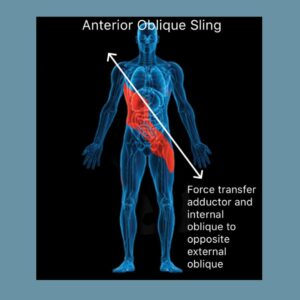
This sling connects the fascia of our internal and external abdominal oblique muscles with the adductors (inner thigh muscles) on the opposite side. It stabilises our standing leg when walking or running and helps bring the pelvis forward as the other leg comes through for our heel strike. Weakness or imbalance along the chain can lead to groin or back pain.
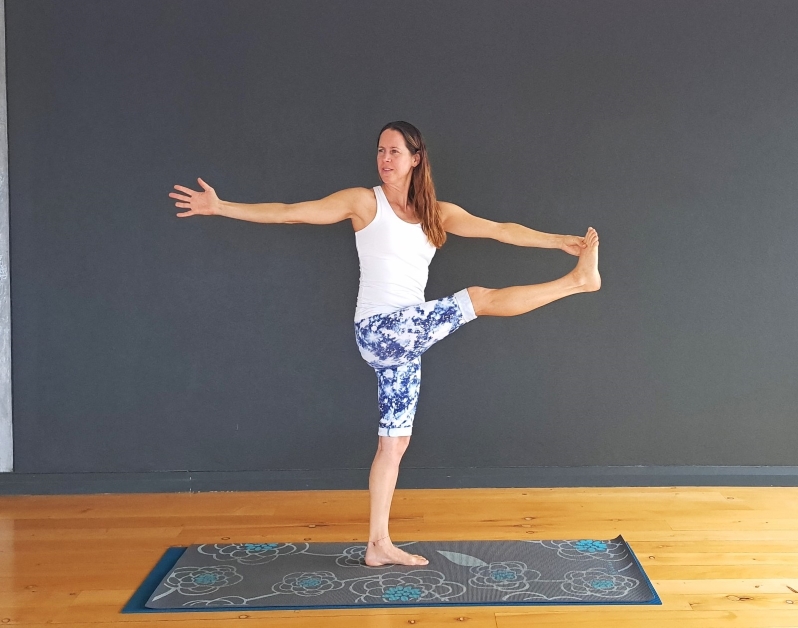
Yoga poses that utilise this sling are standing twists where one leg is raised and held with the opposite arm, such as hasta padangusthasana, lunge twist (parivritta parsvakonasana), chair twist, side crow (parsva bakasana) and more.
2. Posterior Oblique Sling (POS)
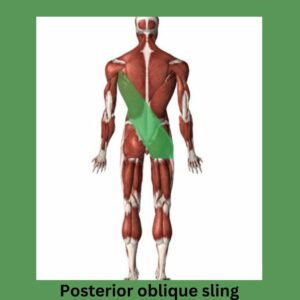
This sling connects the gluteus maximus on one side with latissimus dorsi on the opposite side, via the thoracolumbar fascia. So it essentially connects our buttock on one side with the opposite shoulder. It helps us to stand and stabilises the SI (sacroiliac) joint when balancing on one leg. It is also instrumental during running or swimming freestyle when the opposite arm and shoulder pull back simultaneously. The thoracolumbar fascia in particular is complex and multi-layered, with problems there often contributing to back pain.
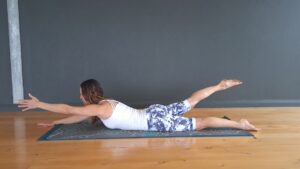
In yoga we strengthen this area when practising locust (salabhasana) variations on the floor where we lift the opposite arm and leg. It would be involved in mad dog, as we hold our foot with the opposite arm. When lifting the opposite arm and leg on all fours we engage this area and if we then bring our knee towards our opposite elbow and round the back we can tension the fascia in this sling, making it stronger.
3. The Lateral Sling
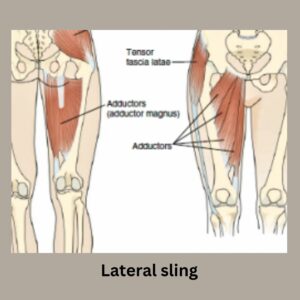
This sling is formed by the outer hip muscles (gluteus medius, minimus and tensor fascia lata) on one side linking to the adductors (inner thigh muscles) on the opposite side. It helps maintain a balanced alignment of the pelvis, particularly when standing on one leg. If it is dysfunctional, the pelvis can tilt or drop laterally, making one hip higher than the other.
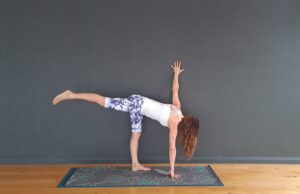
In yoga, this sling would need to work optimally to support tree pose (vrikasana) with a balanced pelvis and would also come into play during Warrior 3 (virabadrasana 3) and revolved half moon pose (parivritta ardha chandrasana).
4. The Deep Longitudinal Sling
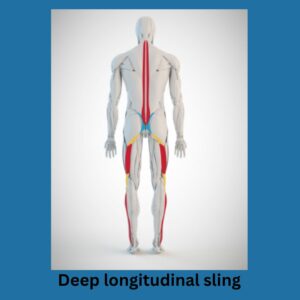
This is the only myofascial sling that doesn’t run diagonally, as it goes from the erector spinae (the long muscles running either side of the spine) to the hamstrings, via the thoracolumbar fascia and sacrotuberous ligament. It works in various ways, helping keep the body upright in standing, extending the spine (backbending it) and stabilising the lower back and pelvis. It is also known as the ‘great communicator’ as it helps the lower body sense where the upper body is in space.
This sling is involved in all our standing yoga poses and can also be activated in bridge variations where one leg is raised like ekapada setu bandha or urdhva dhanurasana.

I hope this understanding of the deeper complexities of the body will bring new awareness into your yoga practice and an appreciation of these incredible forms we inhabit. Thinking beyond the linear concept of muscle-operated bony levers can allow us to experience movement in a much more three-dimensional way.
Bring diagonal slings into your practice, with some of the poses described above. Or play around with crawling in different ways to benefit your body and brain. Join my online yoga video library to practice the class, On the Diagonal with me – based on these concepts.