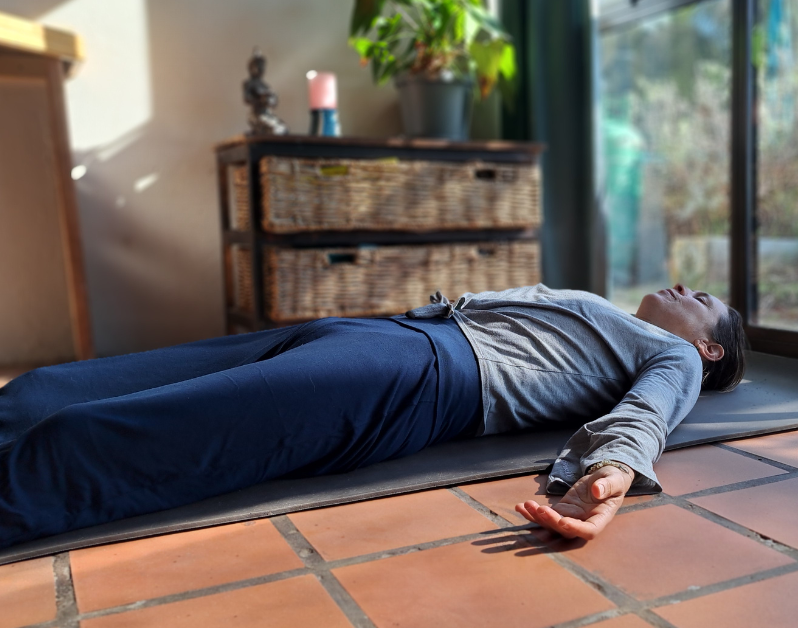
Forget handstands and arm balances—if you want to know which pose I find the most challenging at the moment, I have to say its savasana. It wasn’t always this way. I used to savour a deep rest in this supine pose to complete my practice, but these days I always seem to find an excuse to skip it.
My logical mind is fully cognizant that in this frenetic era, laden with distractions and overstimulation, savasana is the perfect medicine for our fraught nervous systems. Yet I have become like many others in this time who are addicted to movement while avoiding stillness.
There is a ream of reasons as to why the practice of lying on our backs and resting without falling asleep is so incredibly beneficial. Savasana can be classified as a Non-Sleep Deep Relaxation (NSDR) practice—a term invented by Stanford neuroscientist Andrew Huberman. Studies have shown that regular practice of savasana reduces stress along with cortisol levels. It can stimulate a release of the feel-good hormone, dopamine, improve blood flow through our brains, balance blood sugar levels and boost our immune systems. When we are resting in this way, our brain’s creativity centres light up too.
After a yoga practice, savasana allows us to release any traces of tension that might still remain within us. At the same time, our minds are able to process and integrate what we have learned during the preceding practice. This rest and reset improves our ability to focus as well as our memory.
In the eyes of many yoga teachers, savasana is the gateway leading from our physical practice to a deeper spiritual practice. Our attention is guided inwards in a form of interoception or sensing of our inner world. When we sink into relaxation, our brainwaves transform into delta waves, as in deep sleep. Teachers say that in this state we can often experience the effect of our yoga practice on the body’s energy field and detect any subtle changes that have happened.
So why am I omitting this wonderful technique from my yoga practice? It’s no problem when I am lying in another teacher’s class, guided by a soothing voice into surrender. But on my own, without a recording and just the ticking of the clock in the background, ten minutes mutate into ten hours in my mind. I struggle to settle down.
That is going to change. My goal for this winter is to gradually extend my daily savasana practice, starting with five minutes and increasing to ten minutes of deep rest with a mind that is deeply calm, yet alert and attentive. I will share the results of my experiment—so watch this space. And if you find corpse pose as challenging as I do, I dare you to join me.